Bank of England Raises Base Rate to 4%: What It Means for London New Build Buyers

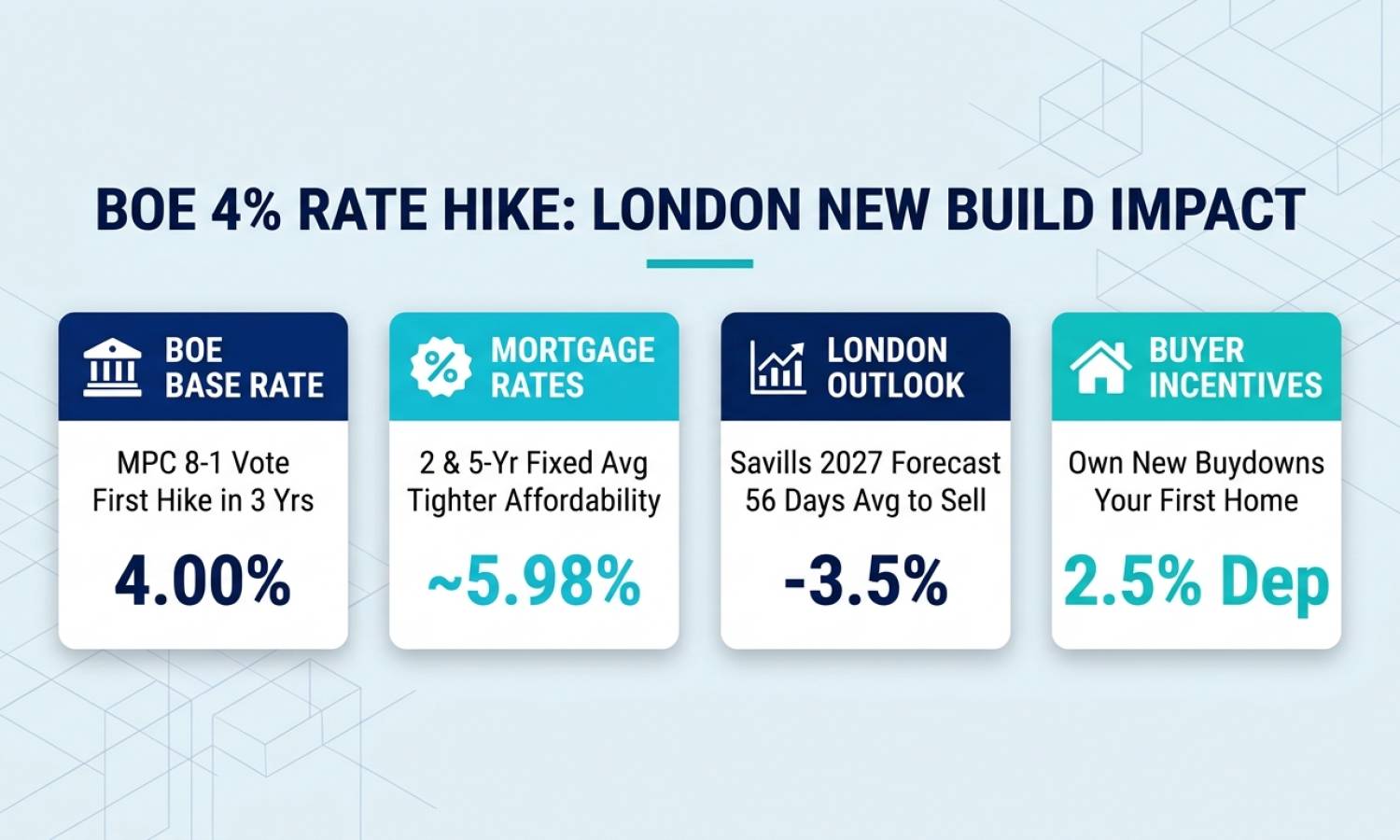
The Bank of England raised the UK base rate by 0.25 percentage points to 4.00% on 5 November 2026, marking the first increase in over three years. Alongside sticky 3.5% inflation and average fixed mortgage rates near 6%, revised forecasts from Savills point to mild London price adjustments in 2027, shifting negotiating power firmly toward buyers.
For homebuyers and investors comparing new build developments in London, this monetary policy turn changes the arithmetic of buying. While second-hand sellers face an average 56-day wait to agree a sale, major housebuilders are countering higher borrowing costs with mortgage rate subsidies and upfront purchase incentives.
Key UK Market Metrics After the November 2026 Rate Decision
Recent institutional releases from the Bank of England, Savills, Lloyds Bank, and Nationwide reveal a clear divergence between wider national affordability pressures and active support inside the new build sector:
| Market Indicator | Current Figure (Nov 2026) | Primary Institution | Direct Impact on Buyers |
|---|---|---|---|
| Bank of England Base Rate | 4.00% (+0.25%) | Bank of England MPC (8–1 vote) | Immediate rise on tracker and SVR mortgages |
| Average 2 & 5-Yr Fixed Rates | 5.97% – 5.99% | UK Lender Benchmarks | Higher stress-testing limits for 90–95% LTV borrowers |
| UK Average Property Price | £296,285 (-0.6% Oct) | Lloyds Bank / Halifax | Steepest monthly national dip in three years |
| London 2027 Price Forecast | -3.5% (Mainstream) | Savills Research | Stronger scope to negotiate asking-price discounts |
| Average London Time to Sell | 56 days | UK Market Activity Data | Reduced buyer competition and slower chains |
Why the Bank of England Raised Rates and What Happens to Mortgages
The Monetary Policy Committee voted 8 to 1 to lift the base rate from 3.75% to 4.00% after UK Consumer Prices Index (CPI) inflation climbed to 3.5%, driven largely by energy supply shocks pushing oil above $100 a barrel. Analysts warn that if energy costs remain elevated, a further rise toward 4.25% in early 2027 remains possible.
Because mortgage lenders priced the move in ahead of the 5 November announcement, average two-year and five-year fixed products stayed close to 5.98% rather than jumping overnight. However, commercial lenders have shortened product shelf lives and tightened affordability calculations, keeping monthly mortgage approvals across the UK subdued below 60,000.
Savills models average mortgage rates holding near 5.32% at the end of 2026 and easing gradually to 5.09% across 2027 before returning toward the low-4% bracket in 2028. Buyers entering the market now should therefore stress-test repayments assuming 5.5% to 6.0% borrowing costs rather than relying on rapid rate cuts.
London House Price Outlook: Second-Hand Stock vs New Builds
London residential prices have softened by roughly 1% year-on-year, with Lloyds data recording a 0.6% national monthly drop in October to £296,285 and Nationwide reporting annual growth slowing to 0.5%. In mid-market London brackets between £1M and £3M, sales timelines have stretched to between three and six months.
In its November 2026 forecast update, Savills projected mainstream UK prices dipping 1.5% in 2027, while southern regions with tighter income-to-price ratios, including London, the South East, and the East of England, face a projected 3.5% adjustment before a broader 15.8% five-year recovery through 2031.
Crucially, Savills notes that newly built homes do not move identically to second-hand properties. New developments face rigid construction cost floors and reduced regional starts as developers tighten pipelines, preventing distressed price drops while encouraging targeted incentives instead of headline list-price cuts.
How New Build Buyers Counter 6% Mortgages in Late 2026
Purchasing a newly constructed home gives buyers access to structured financing tools that private second-hand sellers cannot match. When evaluating new build flats in London, three practical routes help offset elevated commercial interest rates:
- Developer Rate Buydowns: Through the Own New Rate Reducer scheme, participating housebuilders contribute 3% to 5% of the purchase price directly toward lowering your commercial mortgage interest rate for the initial two-year or five-year fix, cutting monthly payments without changing the property's registered price.
- Low-Deposit Government Equity Loans: Confirmed in the Autumn Budget for 2027 rollouts, the Your First Home scheme pairs a 2.5% buyer deposit with a 20% interest-free equity loan, placing buyers into lower 77.5% loan-to-value (LTV) mortgage tiers.
- Permanent Discounted Schemes: Eligible first-time buyers and key workers can still access 30% to 50% below-market pricing via the First Homes Scheme, subject to local London borough caps of £420,000.
Balancing Incentives Against Running Costs and Yields
Negotiating power does not remove the need for disciplined due diligence. Buyers locking in developer Stamp Duty contributions or furniture packages must still check long-term holding expenses, particularly in developments with lifts, 24-hour concierges, and communal heating networks.
Before signing reservations, review our breakdown of London new build service charges to verify annual per-square-foot costs and reserve fund contributions. For buy-to-let investors weighing 5.5%+ mortgage costs against cashflow, focus strictly on high-yield outer nodes detailed in our guide to the highest rental yield postcodes in London, where outer Zone 4 and Zone 5 yields reach 6.0% to 7.2%.
Practical Checklist for London Buyers Right Now
With average London properties taking 56 days to sell and developers managing year-end sales targets, prepared buyers hold clear advantages:
- Secure a Decision in Principle (DIP) Early: Product withdrawals happen quickly when swap rates shift, so lock in a valid mortgage offer for three to six months while negotiating.
- Negotiate Value Over Headline Cuts: Ask sales offices for Stamp Duty payments, legal fee contributions, or two-year service charge holidays if headline prices are fixed for valuation purposes.
- Check Energy Efficiency (EPC): New builds with EPC A or B ratings qualify for green mortgage rate discounts from major UK banks and avoid future private-rented retrofit costs.