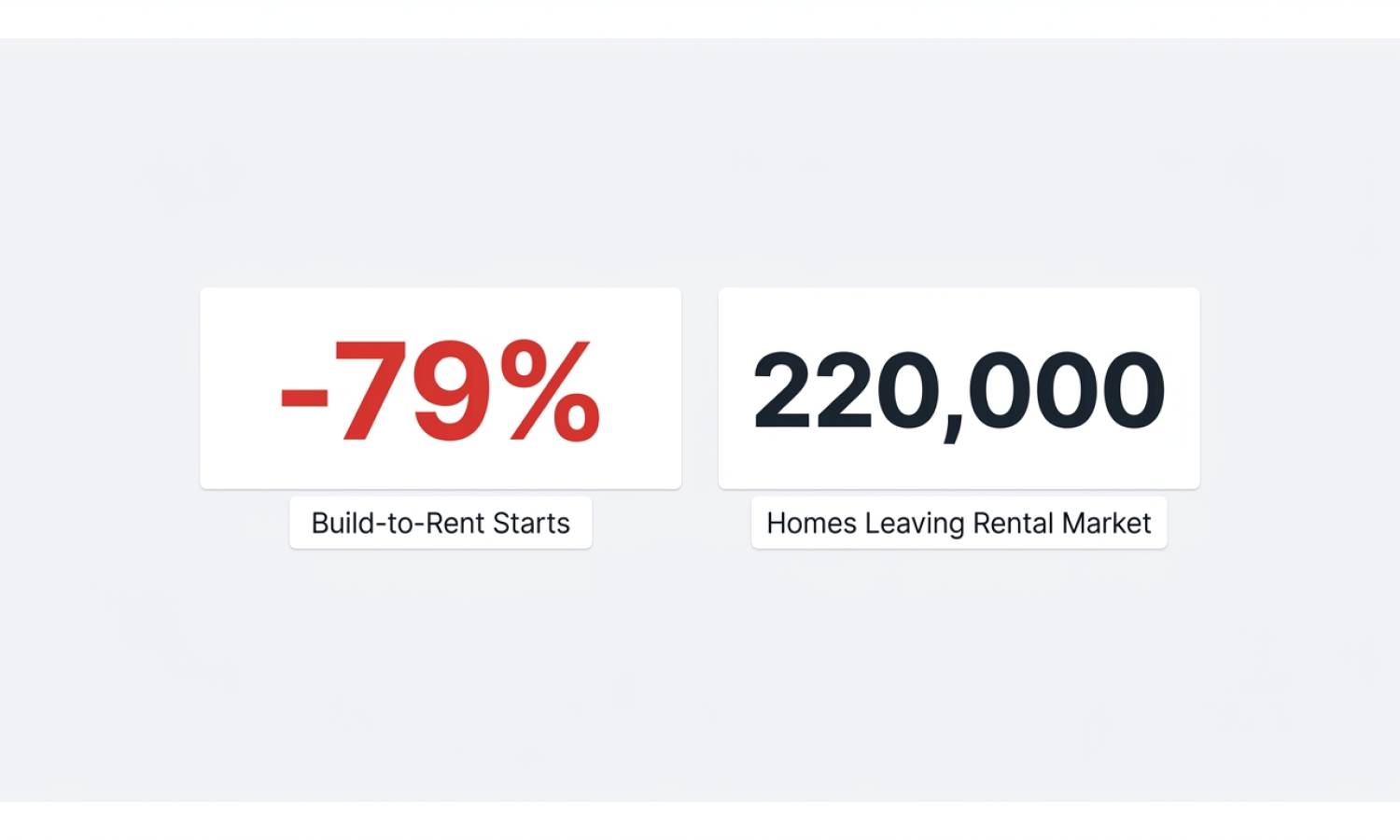
Build-to-Rent Starts Down 79% as 220,000 Homes Leave the Rental Market

Build-to-Rent was supposed to be the answer. As private landlords sold up and left the market in growing numbers, purpose-built rental housing run by professional operators was meant to pick up the slack. The data from Q2 2026 tells a different story.
New BTR construction starts across the UK fell by 79% in the year to June 2026, dropping to just 3,455 homes. At the same time, an estimated 220,000 private rental properties are on track to leave the market by the end of the year. Both sides of the rental supply equation are contracting at once.
The Numbers Behind the BTR Slowdown
The Q2 2026 report by Savills for Real Estate:UK (RE:UK) shows the sharpest annual decline in BTR construction activity on record. Here is what happened:
| Metric | Figure | Change |
|---|---|---|
| UK BTR starts (year to June 2026) | 3,455 homes | -79% year-on-year |
| Regional starts (outside London) | 2,176 homes | -84% (from 13,893) |
| Homes under construction (UK) | Declining | -21% nationally; -27% in London |
| Completions vs. starts | Completions exceed starts | 10th consecutive quarter |
| Total BTR stock (UK) | 310,310 homes (156,688 completed) | ~8% of new housing delivery |
The last line is the one that matters most for the medium term: completions have exceeded new starts for ten straight quarters. The existing pipeline is being consumed without replacement. Every quarter that continues, the future delivery gap widens.
Why Developers Stopped Building
Three forces converged to freeze the BTR pipeline:
Viability. Construction costs for labour and materials have stayed elevated since the 2022-2024 inflationary cycle. Margins on new BTR schemes have tightened to the point where many projects simply do not work on paper. Outside London, where rents are lower but construction costs are similar, the economics collapsed first, which is why regional starts fell 84% against London's smaller decline.
Rent control fears. The Savills survey found that 100% of BTR investors said they would have reduced investment and avoided mayoral areas if rent controls had been introduced. Even without formal controls, the political discussion around them created enough uncertainty to delay or cancel investment decisions. Capital does not wait around for policy clarity. It moves to markets where the rules are settled.
Capital flight to existing assets. Investor money has not left the BTR sector entirely. It has shifted from funding new construction to buying completed, operational buildings. Stabilised assets with tenants already in place carry less risk than a two-year development cycle. The result: money still flows, but no new homes get built.
The Private Landlord Exit
The other half of the problem is the traditional rental sector. Roughly 220,000 private rental homes in England are projected to leave the market by the end of 2026, about 5% of total private rental stock.
The Renters' Rights Act, which came into force on 1 May 2026, is the trigger for many of these exits. The act abolished Section 21 "no-fault" evictions, converted most tenancies to rolling periodic agreements, and limited rent increases to once per year. For professional landlords with portfolios and systems in place, these changes are manageable. For the 60% of private landlords in England who own a single property, the regulatory burden now sits on top of mortgage interest restrictions (Section 24), rising EPC requirements, and the stamp duty surcharge on additional properties.
The result is predictable: small landlords are selling, and the homes they sell are not always staying in the rental sector. Some are bought by owner-occupiers. Some sit empty during a protracted sales process. The net effect is fewer homes available to rent.
What This Means for London
London sits at the intersection of both forces. BTR construction in the capital fell 27% year-on-year, while private landlord sales have accelerated in boroughs where yields were already marginal.
For renters, the outlook is straightforward: competition for available homes will remain intense. Average rents in London are already above 2,200 per month and growing at 6% annually. With both new BTR delivery and traditional landlord supply contracting, there is no near-term relief in the pipeline.
For investors buying new builds in London, the same dynamics that are painful for renters represent an opportunity. Rental demand is rising. Supply is falling. Gross yields in outer London corridors like new builds in Greenwich, Ilford, and Walthamstow are running between 5.2% and 6.8%. The properties that institutional BTR operators are not building are the same types that individual investors can acquire at developer discounts that remain available across multiple schemes.
Buyers who can move now are purchasing into a tightening rental market. Those who wait are likely to face higher acquisition costs once the supply contraction becomes visible in headline figures over the next 12 to 18 months.
Practical Takeaways
If you are a renter: Lock in your tenancy. The Renters' Rights Act gives you the right to stay on a rolling basis, and rent increases are capped at once per year at market rate. If your current rent is below market, you are in a better position than you may realise.
If you are looking to buy to let: Outer London new builds offer a combination of developer incentives, warranty coverage, and rental yields that match or exceed many BTR returns. The key is buying at the right price in areas where tenant demand is sustained by transport links and employment access. Off-plan property lets you lock in today's price with completion and mortgage draw-down 12 to 24 months later.
If you are a first-time buyer: Falling landlord supply means more ex-rental properties appearing on the resale market. Areas with lower entry prices, like new builds in Woolwich, give first-time buyers a realistic path to ownership in a well-connected part of London without stretching beyond their means.
The rental supply crisis is not a headline. It is a structural shift that will take years to reverse. The BTR sector, which was meant to absorb the shock, is contracting at the same time. That makes the current moment one of the most significant for anyone making a rental or investment decision in London.