The Elizabeth Line & Superloop Effect: Best London New Builds for Capital Growth

The Elizabeth line and Superloop express bus network have created London's strongest capital growth corridors. Properties within a 10-minute walk of Elizabeth line stations have achieved 15% to 25% higher price appreciation than the Greater London average, while offering 15-to-25 minute direct connections to Canary Wharf, the City, and the West End.
For buyers and buy-to-let investors, rapid transport connectivity remains the single most reliable driver of long-term property value. The combination of high-frequency rail and outer-ring orbital bus routes has permanently reshaped London's commuter map, pulling outer suburban zones into prime rental contention.
Elizabeth Line Station Hubs: Price and Commute Benchmarks
Major regeneration masterplans along the purple line offer distinct price points and journey times across East, South East, and West London. Here is how key station hubs benchmark in 2026:
| Station Hub | Travel Zone | Canary Wharf / City Commute | Average £/sq ft | Starting 1-Bed Price |
|---|---|---|---|---|
| Abbey Wood (Thamesmead) | Zone 4 | 11 mins (Canary Wharf) | £450 – £520 | £275,000 |
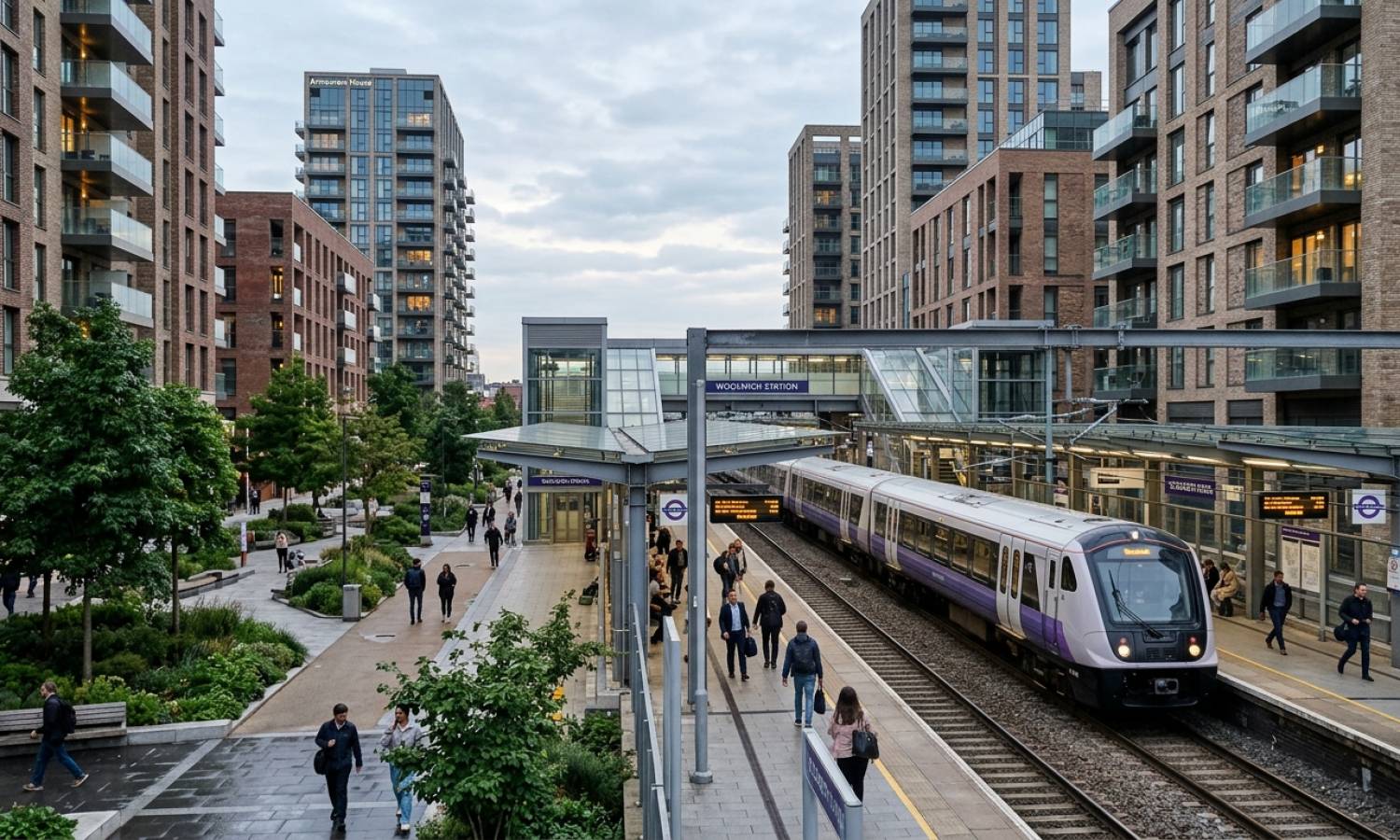
| Woolwich | Zone 4 | 14 mins (Liverpool Street) | £600 – £750 | £385,000 |
| Custom House (Royal Docks) | Zone 3 | 10 mins (Liverpool Street) | £680 – £820 | £420,000 |
| Stratford | Zone 2 / 3 | 8 mins (Liverpool Street) | £700 – £880 | £435,000 |
| Hayes & Harlington | Zone 5 | 20 mins (Paddington) / 27 mins (Bond St) | £500 – £590 | £315,000 |
| Southall / West Ealing | Zone 3 / 4 | 15 mins (Paddington) | £580 – £720 | £370,000 |
Top 4 Elizabeth Line New Build Hotspots
1. Abbey Wood and Thamesmead (Zone 4)
As the southeastern terminus of the Elizabeth line, Abbey Wood represents one of the most accessible entry points in the capital. Direct trains reach Canary Wharf in 11 minutes and Liverpool Street in 17 minutes.
Developments such as Southmere in neighbouring Thamesmead combine lakeside settings and civic libraries with prices significantly below inner-city benchmarks. Browse available options across new builds in Bexley and neighbouring Greenwich.
2. Hayes and Harlington (Zone 5)
West London has traditionally carried steep pricing, but Hayes offers modern apartment living at substantial discounts compared to neighbouring Ealing. Fast services connect westward to Heathrow in under 10 minutes and eastward to the West End in under half an hour.
Flagship schemes like Hayes Village redevelop historic canal-side commercial sites into residential communities with direct walking access to the station concourse.
3. Stratford and Newham Interchange (Zone 2/3)
Stratford is London's busiest transport interchange, combining the Elizabeth line, Central and Jubilee underground lines, DLR, and national rail services. Commuters reach the City of London in under 10 minutes.
Projects like International Way in Newham cater directly to young professionals who demand immediate transit access alongside Westfield shopping and Queen Elizabeth Olympic Park facilities.
4. Custom House and Royal Docks (Zone 3)
The Royal Docks waterfront is undergoing a multi-billion-pound regeneration programme. Custom House station provides a 3-minute transit link to Canary Wharf and direct high-speed service to Farringdon and Tottenham Court Road.
Waterfront developments here attract strong international interest due to proximity to London City Airport, Excel London, and the new City Hall headquarters.
The Superloop Multiplier: Outer London Orbital Connectivity
While the Elizabeth line connects east and west across central London, Transport for London's Superloop bus network provides high-speed orbital express routes linking outer town centres.
Express routes like the SL2 connect Walthamstow, Ilford, and Barking Riverside, while the SL7 links Heathrow, Kingston, and Croydon. This orbital infrastructure allows commuters to reach Elizabeth line interchanges without having to travel through central London fare zones.
Masterplans like Beam Park benefit directly from this secondary transport network, connecting outer residential developments with major employment and retail nodes.
Rental Yields and Tenant Demand Along the Line
From an investment perspective, Elizabeth line developments consistently exhibit shorter void periods and higher rental premiums than standalone suburban developments.
Rental stock located within a 10-minute walk of Elizabeth line platforms achieves average letting turnarounds of under 14 days. Gross rental yields in outer nodes like Abbey Wood and Hayes average between 5.4% and 6.5%, compared to 3.2% to 3.8% in Zone 1 locations.
Tenants actively prioritise travel time over postal geography. A flat in Zone 4 that reaches the office in 15 minutes routinely commands a higher rent than a Zone 2 flat that requires two bus connections and a 45-minute commute.
Key Buyer Checks Before Exchanging Contracts
Before placing a deposit on a transport-linked new build, verify these crucial factors:
- Measure Real Walk Times: Marketing materials often quote straight-line distances. Check the exact pedestrian route to the station entrance, especially during peak commute hours.
- Acoustic Glazing Specifications: If the development is adjacent to surface-level rail tracks, confirm acoustic double or triple glazing ratings and mechanical ventilation (MVHR) installations.
- Review Estate Service Charges: On-site amenities like private gyms and concierge desks add convenience but increase annual running costs. Read our complete guide to London new build service charges to budget accurately.
- Compare Accessible Price Points: If you are looking for properties priced below median thresholds, explore our breakdown of cheapest areas to buy new builds under £500k or filter live developments directly in our new homes up to £500,000 catalog.
Frequently Asked Questions
FAQ
Studies show residential properties within a 10-minute walk of Elizabeth line stations have achieved 15% to 25% higher capital growth than wider Greater London property averages since construction began, with outer stations like Abbey Wood and Hayes seeing the strongest percentage increases.
Abbey Wood in South East London remains the most affordable Elizabeth line station hub for new builds in 2026, with starting prices for one-bedroom apartments from £275,000 and average prices between £450 and £520 per square foot.
The Superloop is TfL's express bus network connecting key outer London town centres, hospitals, and transport hubs. Developments located along Superloop routes gain faster access to Elizabeth line and Underground interchanges, boosting tenant demand and long-term resale liquidity.
Yes. Outer Elizabeth line hubs currently deliver gross rental yields between 5.4% and 6.5%, driven by high demand from City and Canary Wharf professionals seeking fast commutes at affordable rental rates.